

LimeWire Just Joked About Its Infamous $72 Trillion Copyright Case
More than two decades after LimeWire became one of the defining names of the early file-sharing era, the brand is once again leaning into the chaos that made it famous. On September 29, LimeWire joked that the music industry once tried to sue the platform for $72 trillion, ending the post with a simple message: “still not paying.”
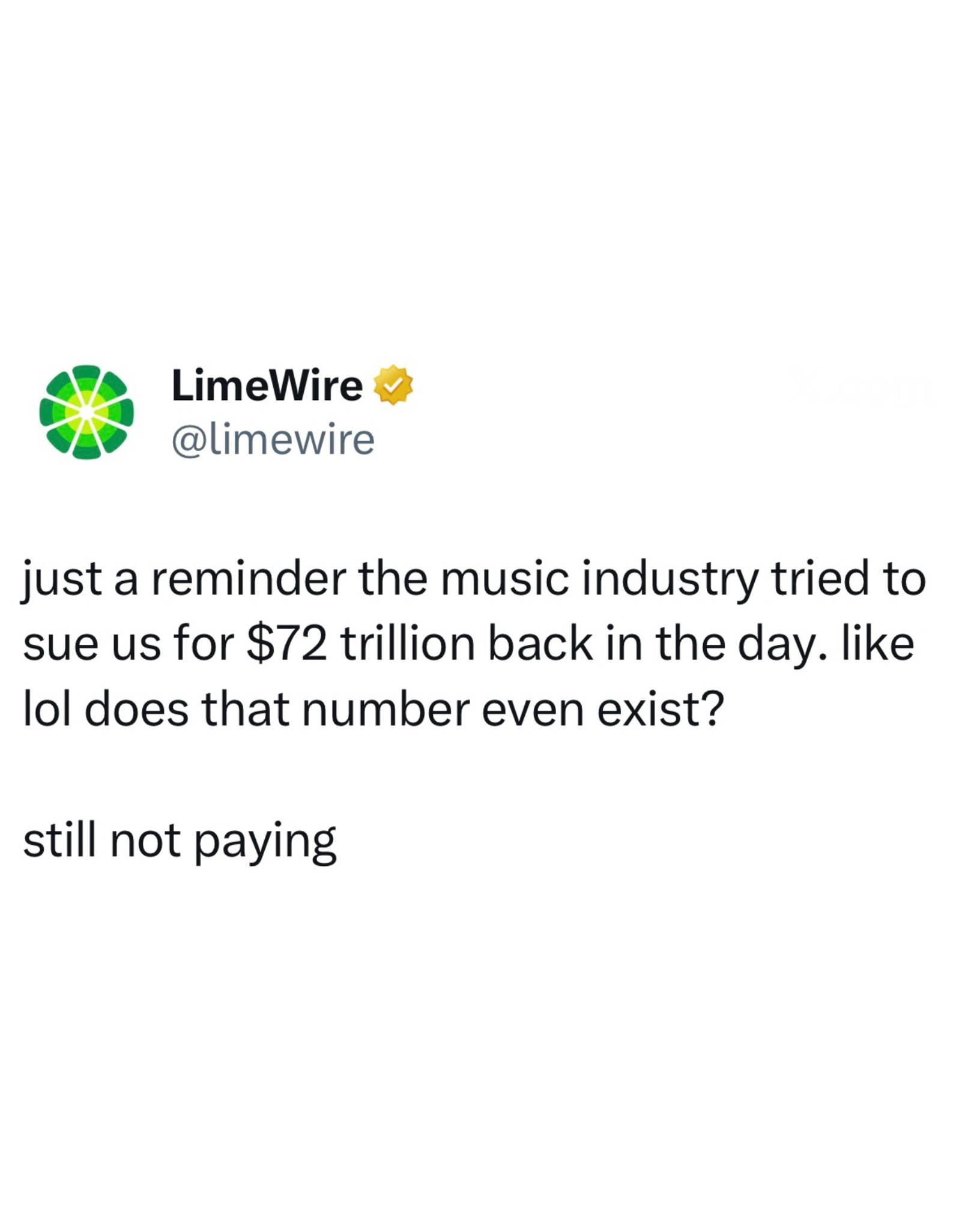
Founded in 2000, LimeWire quickly became one of the most recognizable peer-to-peer file-sharing programs on the internet. Millions of users relied on it to search for and download MP3s directly from other computers, but much of the music being exchanged through the service was copyrighted, eventually putting the company in direct conflict with major record labels.
That legal battle reached a major turning point in 2010, when U.S. District Judge Kimba Wood found LimeWire liable for inducing copyright infringement. Court filings later identified roughly 11,000 sound recordings connected to the case, setting the stage for a much larger fight over how damages should be calculated.
The famous $72 trillion figure came from an interpretation of statutory damages that could have allowed awards to accumulate across infringements carried out by individual LimeWire users. With thousands of songs and massive numbers of downloads involved, that method could theoretically push the total into the trillions. However, LimeWire was never actually ordered to pay $72 trillion.
Judge Kimba Wood rejected that damages interpretation, noting that it could create awards reaching into the trillions and produce an absurd result. The court instead limited how statutory damages could be calculated in the case, meaning the infamous $72 trillion figure became more of a symbol of the lawsuit’s scale than an actual final judgment.
The legal fight ultimately ended in 2011, when LimeWire and its founder reached a settlement with the record labels for $105 million. By then, the original LimeWire service had already been effectively shut down following a federal court order that forced the company to stop distributing and supporting its peer-to-peer software.
The LimeWire posting today is also not the same company involved in the original lawsuit. The brand was relaunched under new ownership in 2022, with no affiliation to the original Lime Wire LLC or Lime Group LLC, and has since evolved into a platform focused on file sharing, decentralized storage and AI-powered tools.
That makes the new post even more fitting. More than 15 years after one of the most notorious copyright battles of the early internet, the modern LimeWire is now turning that history into a meme — proving that even a theoretical $72 trillion lawsuit can eventually become nostalgia.
Related News



Latest News

Hard Techno Power Couple Nico Moreno and NOVAH Announce Engagement
Oct 21

Martin Garrix Announces New Album “MARTY” After Returning To His First-Ever DJ Venue 15 Years Later
Oct 21

Ones To Watch: Cyclops Built His Own Lane Through Dubstep And Absurdity
Oct 21

The History Behind Hulaween’s Five Stages: From A 1990s Amphitheater To An Underground Dance Floor
Oct 21

Hulaween 2026: The Ultimate Festival Survival Guide
Oct 20
Trending
- 01Martin Garrix Announces New Album “MARTY” After Returning To His First-Ever DJ Venue 15 Years LaterOct 21
- 02Hulaween 2026: The Ultimate Festival Survival GuideOct 20
- 03DJ Mag vs. 1001Tracklists: Which Ranking Actually Matters More?Oct 19
- 04ADE 2026 DJ Contest Offers 8 Artists a Chance to Perform in AmsterdamOct 08
- 05Celine Orlando Speaks Out About the Impact of After-Midnight Policing Fees on Nightlife VenuesOct 21